

Financial Capacity to Settle in the NT
.png)
Financial Capacity to Settle in the NT: How Much Do You Actually Need?
Moving to a new place is expensive. Everyone knows that in the abstract. Fewer people sit down and put a number on it before they lodge a nomination application.
The Northern Territory guidance does put a number on it. Four numbers, in fact, scaled to who is coming with you. They are not fees, and they are not a bank balance someone is going to hold in trust. They are an estimate of the financial resources you may need to land in the Territory and stay standing.
Here is the table, and here is what sits underneath it.
The financial capacity table
The guidance on the level of financial resources you may need, depending on your family composition:
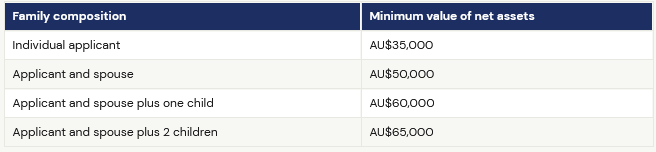
Read the increments and you can see the logic. A spouse adds AU$15,000 to the figure; the first child adds AU$10,000; the second adds AU$5,000. The curve flattens as the household grows, which is roughly how household costs behave in real life.
"Net assets" is the phrase that matters
The column heading is not "savings" and it is not "income". It is minimum value of net assets — in ordinary usage, what you own less what you owe.
That distinction changes who clears the bar and who doesn't.
An applicant on a strong salary carrying substantial personal debt can present a much thinner net position than a colleague earning less with no liabilities. Someone with equity in property overseas may be well past the figure on paper, while having very little that can be turned into rent and a bond in the first month. Both of those are worth thinking about honestly before you rely on a number.
Two practical questions are worth asking of your own position. First: if you subtracted every loan, card balance and outstanding obligation from everything you own, where would you actually land? Second: how much of what remains could you convert to cash in the weeks around your move?
Why the Territory asks the question at all
The reasoning is stated plainly in the guidance, and it is not subtle.
Skilled migrants to the NT are responsible for supporting themselves when they arrive, and the NT Government does not provide financial assistance.
That is the whole basis for the table. There is no settlement payment, no bridging support, no top-up while you find your feet. Whatever the gap is between arriving and being paid, you are the one who covers it.
Seen that way, the figures stop looking like a hurdle and start looking like what they are — a planning assumption someone else has done the arithmetic on so you don't arrive short.
It is guidance, not a threshold
The wording repays a careful read. The table "provides guidance on the level of financial resources that you may need depending on your family composition."
That sentence is doing two things. It is giving you a serious reference point, and it is declining to promise that the reference point is sufficient for your circumstances. A household with high medical costs, a family that needs a larger home, a move that involves shipping rather than suitcases — none of those are in the table.
It is also worth noticing where the table stops. There is no row for a third child, or for a parent travelling with you. If your household is larger than the last row, the guidance gives you a direction of travel, not a figure, and the planning is yours to do.
The research the guidance hands to you
One instruction sits alongside the numbers: undertake research into the cost of living in the NT and make sure you have the financial capacity to settle successfully.
That is a task, not a formality. Costs vary between Darwin, Palmerston, Alice Springs and remote communities, and they vary with how you choose to live. We are not going to quote you figures here, because the honest answer is that your figures depend on your household — and because the point of the exercise is that you go and find out.
What we would say is this: do the research before you lodge, not after you land. The number you arrive at may change decisions about timing, about how much you ship, or about whether one partner starts work earlier than planned.
Putting your own position in order
The guidance sets out figures. It does not hand you a document checklist. As general good practice — rather than as a stated NT Government requirement — applicants who have thought this through tend to be able to answer three things without hesitating:
- What they own, with current valuations rather than remembered ones, including funds held offshore.
- What they owe, in full, including obligations that will follow them across a border.
- What is liquid in the first month, as distinct from what is merely valuable.
Doing that work early also has a quieter benefit. Financial capacity is one thread in a broader picture of whether your move to the Territory is genuine and durable, and a person who can speak clearly about their own numbers presents very differently from one who cannot.
FAQ
Are these figures fees I have to pay?
No. They are guidance on the minimum value of net assets you may need in order to settle in the NT. They are not a payment to anyone.
Does the NT Government help with settlement costs?
No. Skilled migrants to the NT are responsible for supporting themselves when they arrive, and the NT Government does not provide financial assistance.
Do net assets mean the same thing as savings?
Not quite. Net assets are what you own less what you owe. Savings are one component of that.
What if I have more than two children?
The table stops at an applicant, spouse and two children. Beyond that it offers a direction rather than a figure, and you should plan on the basis of your own household costs and take advice on your circumstances.
Know your number before you lodge
Financial capacity is one of the least glamorous parts of an NT nomination application and one of the easiest to leave until last. It is also one of the few parts where the guidance hands you a plain figure and asks you to be honest with yourself about it.
If you are working out where you sit against that table — or whether your assets look the way you think they look — our team at Maison Chen Law Group can walk through it with you before anything is lodged.
Save this for when you lodge. Then talk to us before you do. Call +61 3 7065 1628.
NT Migration Link: Eligibility requirements for all applicants
Updated: 17 Sep 2026
.svg)


.png)